Welcome to visit ADA MED SUPPLY LIMITED
Phone:+86 13383897707
Email:ada-manikin@adaanatomy.com
Article tag: Multifunctional ACLS Training Manikin/ BIX/ACLS800A/ ACLS800A/
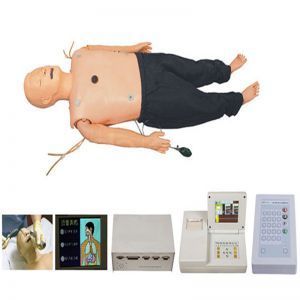
Model | BIX/ACLS800A — Multifunctional ACLS Training Manikin |
Summary | Multifunctional adult ACLS training manikin with CPR feedback, 20 ECG rhythms, real defibrillation and pacing, airway, IV/IM injection and catheterization. |
CPR & Rhythms | 2020 International CPR Guidelines; single or multi-person assessment; real-time graphics; correct/error prompts; statistical printing; full Chinese prompts; 20 ECG rhythms plus a selectable ECG simulator |
Defib / Pacing | Runs from the ECG simulator or a real clinical monitor; accepts real defibrillation and pacing equipment, with corresponding physiological changes |
Airway & Access | Oral and nasal intubation with head / jaw / teeth-stress alarms and manually controllable lung blocking; arm IV (realistic veins, miss sensation, blood return, replaceable) and femoral IM (removable, hundreds of punctures) |
Other & Price | Normal/dilated pupils; weak/strong carotid pulsation; interchangeable genitalia with bladder; ISO 9001 / 14001 / 45001 & CE; USD 3,534.98 |
Educational-use note: ACLS training manikin — educational equipment, not a medical device.
Before ordering: confirm the prompt language (described as Chinese) and whether a 2025-guideline update applies: ada-manikin@adaanatomy.com.
The ACLS800A is an adult ACLS simulator with real defibrillation and pacing, upgraded from the ALS800 with ECG monitoring added. Three capabilities set it apart: it accepts a real clinical defibrillator and pacing device, it stores 20 ECG rhythms with a selectable ECG simulator, and it trains vascular and intramuscular access on replaceable modules.
Where it sits. It is the entry point to real-defibrillation training: ACLS800A at **US 5,302.46), then the digital ACLS800 / ACLS8000 ecosystems (US2,945.82), ACLS170B (US3,682.26 each); BLS entry ALS1200-490 (US $1,472.90).
Two spec details to weigh. The CPR module is labelled to the 2020 International CPR Guidelines while the 2025 AHA Guidelines are now published (section 4), and the prompts are described as full Chinese.
The 2025 AHA Guidelines state that "initial attempts at intravenous (IV) access are recommended over initial attempts at intraosseous (IO) access for adult patients in cardiac arrest," adding that "three large randomized trials failed to demonstrate superiority of initial IO attempts." The guidance restores IV first, IO as the fallback.
The outcome evidence behind it. A 2025 meta-analysis of randomised controlled trials comparing IO with IV access in adult out-of-hospital cardiac arrest pooled 4 RCTs with 9,475 patients. There was no significant difference in survival (6.6% vs 6.9%; OR 0.99, 95% CI 0.84–1.18) or in favourable neurological outcome (4.7% vs 4.6%; OR 1.07, 95% CI 0.88–1.30).
What that means when you buy. If IO and IV are equivalent on survival, the deciding factor is which route your team can get, first attempt, under pressure — and the guideline now asks for IV first. The ACLS800A trains arm IV with realistic veins, a miss sensation and blood return, plus a replaceable femoral IM module: the access skills the new sequence assumes, practised while compressions continue.
Shorter pauses save lives. A 2025 review of defibrillation strategies states that "shorter pre- and peri-shock pauses are associated with higher survival rates," that "biphasic waveform defibrillators are recommended," and sets the sequence: charge during chest compressions, hold compressions for rhythm analysis alone, then shock immediately.
How short is short? A study of manual-mode defibrillation by paramedics opens with the threshold — "pre-shock pause duration of less than 20 s is associated with improved survival after cardiac arrest" — and reports that manual mode defibrillation has been associated with the shortest duration of pre-shock pause.
The technique that shortens it is trainable. A review of 747 treated out-of-hospital cardiac arrests, of which 149 (23.4%) presented in a shockable rhythm, examined compressions during defibrillator charging (CDC) and found it shortened shock pause duration and improved chest compression fraction.
Why the ACLS800A fits this. Manual mode and CDC both need a real defibrillator showing a real rhythm; this manikin runs from real defibrillation and pacing equipment connected to a real clinical monitor, so pause timing is measurable in the room. Timing matters at population level too — a study of 5,753 patients grouped time from collapse to first defibrillation into 0–5, 6–10, 11–15 and 16–60 minutes, with good neurological recovery (CPC 1–2) as the outcome.
Set expectations honestly. An analysis from the Get With The Guidelines–Resuscitation registry covering 472 hospitals and 56,231 Medicare beneficiaries found 10,536 (18.7%) survived to hospital discharge and 8,485 (15.1%) survived to 30 days after discharge; median hospital risk-standardised survival was 18.6%.
Roughly one in five — and no manikin moves that number alone. It makes pause duration, compression quality, rhythm recognition and access route visible and repeatable, the variables the evidence ties to outcomes.
On the 2020 label. The page is built to the 2020 International CPR Guidelines; the 2025 AHA Guidelines change specific recommendations, including the IV-first sequence in section 2. Ask whether the update affects the documentation, and keep the answer in writing.
Where it sits. Real-defibrillation tier: ACLS800A (US 5,302.46) → ACLS800 / ACLS8000 (US 2,945.82), ACLS170B (US 3,682.26 each). BLS entry: ALS1200-490 (US 589.16) and AED98 (US $294.58).
Checklist (defibrillation drill) IV first
● , IO as fallback — drill the sequence the 2025 guidelines set
● Charge during compressions; time the pre-shock pause and hold it under 20 seconds
● Confirm the rhythm on the real monitor before shocking, then shock immediately
● Practise compressions during charging until the pause no longer lengthens
● Rehearse rhythm recognition against the 20 stored ECGs, scoring calls per student
Q1: What is the BIX/ACLS800A? A: An adult ACLS training manikin with 2020-guideline CPR feedback and printing, 20 stored ECG rhythms, real defibrillation and pacing from clinical equipment, airway management, arm IV and femoral IM injection, and catheterization.
Q2: What is the price? A: USD 3,534.98, global shipping. Email ada-manikin@adaanatomy.com for quotation and bulk pricing.
Q3: Can it accept a real defibrillator? A: Yes — it takes the rhythm from the ECG simulator or a real clinical monitor and works with real defibrillation and pacing equipment.
Q4: Does it train IV access? A: Yes — an arm IV module with realistic veins, a miss sensation and blood return, plus a replaceable femoral IM module. That matters because the 2025 guidelines recommend initial IV over IO access.
Q5: What language are the prompts in? A: Described as full Chinese. Confirm available languages for a non-Chinese cohort: ada-manikin@adaanatomy.com.
Q6: Is it built to the current guidelines? A: The page states the 2020 International CPR Guidelines. The 2025 AHA Guidelines change specific recommendations, including IV-first access — ask for written confirmation.
Intraosseous vs Intravenous Access in OHCA: Meta-Analysis of RCTs (2025)
Defibrillation Strategies in Cardiac Arrest: An Update (2025)
Manual Defibrillation, Pre-Shock Pause and Shock Delivery (2015)
Compressions During Defibrillator Charging and Shock Pause (2014)
Time to First Defibrillation and Neurological Outcome (2021)
In-Hospital Cardiac Arrest: Survival to Discharge and Beyond (2024)
Top Things to Know: 2025 AHA Guidelines for CPR and ECC






Leave a comment: