
Welcome to visit ADA MED SUPPLY LIMITED
Phone:+86 13383897707
Email:ada-manikin@adaanatomy.com
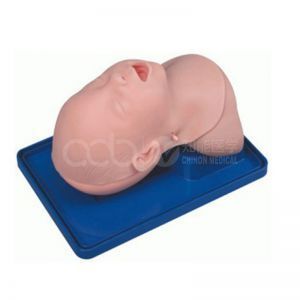
Short answer: The BIX-J3A is a single-purpose infant airway training head: realistic mouth, pharynx and trachea anatomy, an articulating head and neck, and both oral and nasal intubation in one unit. Its teaching value is verification — inflate the tube and you watch the lungs expand while the stomach stays flat, so a candidate learns to confirm tube position rather than assume it. Reference unit price is USD 117.84.
Key takeaways
| Skill | How the head supports it |
| Oral intubation | Mouth, pharynx and trachea moulded to infant anatomy so the blade path is realistic |
| Nasal intubation | The same airway is accessible through the nose for nasotracheal practice |
| Head positioning | The head and neck bend forward so the learner can set and correct alignment |
| Placement verification | Inflating the tube expands the lungs and shows gastric inflation if the tube sits in the oesophagus |
| Team sequence | One head per bench lets a pair rehearse operator and assistant roles |
Neonatal and infant airway management is a separate skill set, and current guidance reflects that. The recent guideline update on neonatal and infant airway management emphasises confirming that the tube is where the operator believes it to be — end-tidal capnography is recommended for verification — and it now folds human factors into its recommendations, because most harm in airway management is a systems and teamwork problem as much as a technical one [1].
The World Health Organization's basic newborn resuscitation guidelines rest on the same logic: they exist because effective resuscitation at birth can prevent a large proportion of neonatal deaths, and that outcome depends on a provider who can deliver ventilation reliably [2]. Against the American Heart Association's current CPR and ECC guidelines — which set the compression, ventilation and team standards your course will be assessed against — a trainee needs repetitions on an airway that behaves predictably [3].
That is what a visible lung-and-stomach feedback loop buys you. Instead of an instructor saying "I think that's in", the learner sees the consequence. Simulation standards ask for exactly this alignment between objectives, fidelity and structured debriefing [4]; a head that answers back simply makes the debrief evidence-based.
A practical 15-minute circuit: demonstrate blade handling on the bench, have the candidate intubate orally three times, verify each attempt by inflating and observing the chest, then repeat through the nasal route and finish with a conscious head-repositioning exercise.
The anatomical features, oral/nasal intubation capability and inflation-verification behaviour above are exactly as published on the product page. The reference unit price of USD 117.84 is the supplier's published figure and is subject to order quantity; the certification statement is the supplier's own listing. The J3A is an educational training aid, not a medical device, and it is not intended for clinical use or for practising on patients. Teach against the current resuscitation guidelines in force in your market [2][3].
Q1. What is the BIX-J3A used for?
Training oral and nasal endotracheal intubation on an infant airway, including head positioning and verifying tube placement by observing lung inflation and gastric insufflation.
Q2. Can it be used for both oral and nasal intubation?
Yes. The moulded mouth, pharynx and trachea allow both routes, which makes it useful when a course teaches the nasal approach as a fallback.
Q3. How does the trainee confirm the tube is in the right place?
By inflating through the tube: correct placement expands the lungs, while oesophageal placement shows air entering the stomach.
Q4. Does the head position move?
Yes. The head and neck bend forward, so the candidate can set and correct alignment the way they would on a patient.
Q5. What does it cost?
The published reference unit price is USD 117.84, subject to order quantity. Ask us for a firm quotation including shipping to your country.
Q6. How do I get a quotation or the specification sheet?
Email ada-manikin@adaanatomy.com with the model (BIX-J3A), quantity and destination. Our team will send pricing, lead time and the official specification on request.
Email ada-manikin@adaanatomy.com for the BIX-J3A price list and shipping details. If you are building a paediatric airway station, we can also quote the BIX-J2A neonate intubation head and the BIX-J5S electronic airway trainer from the same line, so your students progress from neonate to adult on consistent equipment.
1. Guideline update: Neonatal and infant airway management. https://www.em-consulte.com/article/1841317/guideline-update-neonatal-and-infant-airway-manage
2. World Health Organization. Guidelines on basic newborn resuscitation. https://www.who.int/publications/i/item/9789241503693
3. American Heart Association. 2025 AHA Guidelines for CPR and ECC. https://cpr.heart.org/en/resuscitation-science/cpr-and-ecc-guidelines
4. INACSL. Healthcare Simulation Standards of Best Practice. https://www.inacsl.org/healthcare-simulation-standards






Leave a comment: