
Welcome to visit ADA MED SUPPLY LIMITED
Phone:+86 13383897707
Email:ada-manikin@adaanatomy.com
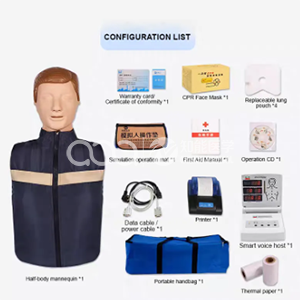
Model | BIX/CPR260 — Computer Half Body CPR Training Manikin with Printer |
Summary | Computer half-body CPR manikin with 5-6 cm depth light indicators, 30:2 cycle at 100/min, 500-1000 ml ventilation display, pupil check and detachable printer. |
Depth Feedback | Light indicator: 5–6 cm green, under 5 cm yellow, over 6 cm red; counter of correct/wrong compressions; spoken error reason |
Ventilation Feedback | Mouth-to-mouth; indicator light shows volume from 500/600 ml to 1,000 ml; counter and spoken prompts |
Cycle, Rate, Modes | 30:2 (one or two rescuers); one cycle = five sets; 100/min; exercise and examine modes; second timing; volume control; detachable printer; pupil examination |
Certification / Price | AHA 2020 compliant, ISO 13485 factory (page-stated); USD 441.88; 12-month warranty |
Educational-use note: training manikin — educational equipment, not a medical device. Cost the printer and consumable lung/face pieces into the programme.
This is a scoring manikin, not just a practice body. Everything it contains exists to grade four numbers:
The manikin grades | Its threshold | Guideline target |
Compression depth | 5–6 cm (green) | 5–6 cm |
Ventilation volume | 500–1,000 ml | ~500–600 ml per breath |
Ratio and cycle | 30:2, five cycles | 30:2 |
Rate | 100/min | 100–120/min |
Because the thresholds are hard-coded, the honest question is whether those numbers sit where the evidence puts them — and what the machine's counter can and cannot tell you. The next four sections test each one.
The green zone is the right window. In a study of 50 healthcare providers (58% ICU nurses) on a calibrated training manikin, the guideline endpoint used to judge quality was 50–60 mm depth with 100–120/min rate; sessions that failed failed mainly on depth, at 46 ± 2 mm. Shallowness, not speed, is the default error.
Depth is tied to survival. Among 593 out-of-hospital cardiac arrests, there were 136 ROSC events (22.9%), 63 survivors to discharge (10.6%) and 50 with favourable outcome (8.4%). Mean depth was 49.8 ± 11.0 mm at 113.9 ± 18.1/min — and survivors were significantly deeper (53.6 mm). That cohort average sits just under the 5 cm floor: a trainee compressing like the average professional would see yellow.
Field data are shallower still. Across 10,371 patients, mean depth was 42 ± 12 mm at 111 ± 19/min, with a compression fraction of 0.70 ± 0.17; 34% achieved return of circulation and 9% survived. A 42 mm mean is firmly in the yellow zone — which is why the depth indicator earns its place.
The 100/min setting is defensible, but the evidence window is a range. In the same 10,371-patient analysis, survival was assessed by rate category (<80, 80–99, 100–119, 120–139, ≥140/min). After adjustment including depth and fraction (n = 6,399) the relationship was significant (p = 0.02), with 100–119/min showing the greatest likelihood of survival; without depth and fraction, no significant relationship appeared (p = 0.19). So 100–120/min is the target band, and rate matters only once depth and fraction are adequate.
30:2 with five cycles per set is the standard structure. The two modes matter more than they look: exercise mode shapes technique, while examine mode with the detachable printer produces a record. Given the documented decay of CPR skills, that printed record is the only way to show a learner improved between sessions rather than merely attended them.
Over-ventilation is measured behaviour. During CPR by professional rescuers in 13 consecutive adults (mean age 63 ± 5.8 years), the average ventilation rate was 30 ± 3.2 per minute, ranging from 15 to 49 — several times the recommended rate — at a mean breath duration of 1.0 ± 0.07 s. No patient survived. The harm from excessive ventilation is well established, and it is why the CPR260 speaks up when a trainee blows too hard or too often.
One caveat is large. A study of 208 pre-hospital clinicians ventilating an adult manikin found an adult bag-valve-mask delivered only 290.4 ml average tidal volume, against 197.1 ml for a paediatric bag (p < 0.001); peak inspiratory pressure was 10.6 vs 8.6 cm H₂O (p < 0.001), and median estimated alveolar ventilation 1,138.1 ml/min (IQR 194.0–2,869.9) against 67.7 ml/min (IQR 0–467.3). Crucially, both bag sizes delivered less volume than guidelines recommend for an adult.
Training implication. With a BVM the common error is under-delivery — the opposite of the mouth-to-mouth instinct this manikin trains. The 500–1,000 ml scale is a legitimate range for mouth-to-mouth, but it does not certify BVM competence.
A light that says "5–6 cm" is only as good as the displacement it actually measures — and measuring compression depth is a known source of error.
In a bench and manikin study, a real-time depth feedback device showed a systematic underestimation of 2–3 mm on a drill press, growing to 4.5 mm in manual tests on a hard surface. On a foam or air mattress, rescuers guided to a 50 mm target produced device readings of 52.0 ± 1.9 mm and 49.4 ± 2.6 mm, while the manikin measured 54.4 ± 1.8 mm and 52.1 ± 1.4 mm. Related work shows a single accelerometer overestimates depth because it ignores mattress compression.
Practical rules: train on a firm, flat surface; treat the colour zone as a teaching signal, not a measurement certificate, since the green/yellow boundary sits at the most error-prone value; and use the printer for trend against the learner's own previous session.
Where it sits. The CPR260 is the half-body manikin that scores depth, volume, ratio and rate with printed records. The BIX/CPR100A is the entry-level half-body unit; the BIX/CPR480 is the full-body electronic option where torso mechanics matter; the BIX/ACLS800A class adds ECG, defibrillation and airway work.
Buying logic: buy the CPR260 when a programme must grade compressions and ventilations and keep a record — certification courses, instructor training, hospital BLS updates. Where nothing needs printing or scoring, a simpler unit covers the same practice.
Checklist (BLS drill)
● Depth inside the green zone across a full five-cycle set
● Ventilation volume inside the marked range on every breath
● 30:2 ratio and a rate near 100/min held through the cycle
● Printed result compared with the learner's previous session
Q1: What does the BIX/CPR260 include? A: A computer half-body CPR manikin with depth light indicators, ventilation volume display, exercise and examine modes, pupil examination, and a detachable printer for operation results.
Q2: How does the depth feedback work? A: A dynamic light shows the zone — green for 5–6 cm, yellow under 5 cm, red over 6 cm — with a digital counter of correct and incorrect compressions and a spoken reason for each error.
Q3: Is it compliant with current guidelines? A: The page states AHA 2020 compliance and a 30:2 ratio at 100/min — inside the 100–120/min band the evidence supports. Confirm the guideline version on your invoice.
Q4: What is the price and MOQ? A: USD 441.88 with a 12-month warranty. Email ada-manikin@adaanatomy.com. for the quotation and bulk terms.
Q5: Does it support bag-valve-mask training? A: The volume display trains mouth-to-mouth technique. Real BVM use tends to under-deliver volume, so add a volume-measuring adjunct if BVM is in scope.
Q6: What certifications and shipping terms apply? A: ISO 13485 certified factory, AHA 2020 compliant (page-stated); global DHL/FedEx shipping: ada-manikin@adaanatomy.com..
Mobile Device Feedback: Depth and Rate Accuracy (2017)
Chest Compression Depth and Survival in OHCA (2014)
Chest Compression Rates and Survival After OHCA (2015)
Hyperventilation-Induced Hypotension During CPR (2004)
Manual Resuscitator Ventilation in a Simulated Adult (2024)
Feedback Accuracy of Compression Depth on Soft Surfaces (2014)






Leave a comment: