
Welcome to visit ADA MED SUPPLY LIMITED
Phone:+86 13383897707
Email:ada-manikin@adaanatomy.com
Article tag: 85cm Both Sex Torso Model 40 Parts/ BIX-A1043/ A1043/
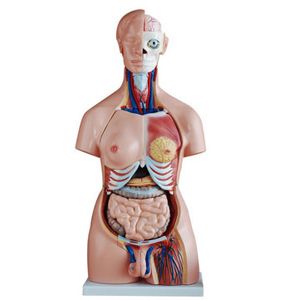
Model | BIX-A1043 — 85cm Both Sex Torso Model, 40 Parts |
Summary | 85cm both-sex torso model with 40 PVC pieces covering brain, spinal nerves, viscera, and male and female reproductive organs with fetus. |
Pieces | 40 (official spec) |
Component List | Torso; female chest cover; head; eyeball; brain (8); spinal nerves (4); lungs (4); heart (2); trachea, esophagus and aorta; diaphragm; liver; kidney; stomach (2); intestine (4); male reproductive organs (4); female reproductive organs with fetus (3) |
Material / Mounting | PVC; placed on a plastic seat (stand) |
Size | 85 cm |
Price | On request (quotation via email) |
Audience | Medical and nursing schools, lecture-hall demonstration, neuroscience and OB/GYN teaching |
Educational-use note: anatomical teaching model — educational equipment, not a medical device. Request the specification sheet by email for finishes and options.
A torso model makes three choices for you: how big it is, how deep it goes, and which patient it represents. The A1043 answers all three: 85 cm, 40 pieces, both sexes in one model.
Size is not vanity. Among 380 students with no prior anatomy knowledge, those studying from models whose longest diameter exceeded 10 cm recalled significantly more anatomical names than those using smaller models (F(2,707) = 17.15, p < 0.05) (Yang et al., 2023). In a lecture hall, size also decides whether the back rows can see the relationship being described.
Physical beats screens — measurably. Students naming structures on a cadaver pelvis scored 67% (with haptic feedback) and 69% (without) using a physical model, versus 41% using three-dimensional visualisation technology (p < 0.0001); in the transfer test the model scored 74% against 43%, an advantage attributed mainly to stereoscopic vision (Wainman et al., 2018).
Physical models also equalise. In a 78-student crossover study there was no overall VR-versus-model difference, but learners with low visuospatial ability performed significantly worse with VR (p = 0.001 immediately; p = 0.003 at 48 hours), while on the physical model low and high ability groups performed similarly well (Wainman et al., 2021).
Evidence | Finding | Relevance to A1043 |
Yang et al., 2023 | RCT, 380 students: models over 10 cm longest diameter gave better anatomy recall (p < 0.05) | Justifies the 85 cm full-size format |
Wainman et al., 2018 | Physical model 67–69% vs 41% for screen learning; 74% vs 43% in transfer test | Hands-on beats screens for spatial anatomy |
Wainman et al., 2021 | VR disadvantaged low-visuospatial learners (p = 0.001 / 0.003); physical models gave similar scores across ability levels | Physical models serve mixed-ability classes |
Estevez et al., 2010 | RCT: building a 3D physical brain model lifted scores, driven by 3D questions; 84% wanted it repeated | Supports a detachable 8-piece brain |
Yi et al., 2019 | RCT, 60 students: 3D printed and 3D image groups beat 2D; printed-model group scored higher on enjoyment and attitude | Physical depth raises engagement |
Kong et al., 2016 | RCT: 3D and printed models beat an atlas; only the atlas group declined at the second examination | Retention favours physical handling |
The 8-piece brain and 4-piece spinal nerves turn the nervous system into a build-and-identify exercise rather than a diagram — the content where physical modelling has been shown to lift scores specifically on three-dimensional questions (Estevez et al., 2010).
Four-part lungs, two-part heart, trachea/esophagus/aorta, diaphragm, liver, kidney, two-part stomach and four-part intestine allow a full dissection sequence in one session, the body wall opening around the organs instead of hiding them.
Male reproductive organs (4) and female reproductive organs with fetus (3) sit in the same model, so students compare the two sets directly rather than studying them on separate models. The comparison is the learning objective, built into the hardware.
The fetus piece supports antenatal teaching: fetal position, the uterus in relation to surrounding structures, and space constraints at term.
At 85 cm on its stand the A1043 is legible from the back of a teaching room; its 40-piece breakdown keeps it useful when the cohort splits into stations.
Model | Size / parts | Configuration | Best for |
A1043 | 85 cm / 40 | Both sexes, with fetus | Full-size demonstration, deepest organ set |
ADA-208 | 85 cm / 40 | Unisex, with genitalia | ADA-brand equivalent format |
ADA-206 | 85 cm / 20 | Sexless | Large-class demonstration, fewer parts |
ADA-209 | 55 cm / 20 | Unisex | Mid-size teaching room |
A1046 | 45 cm / 23 | Both sexes | Comparative organ study |
A1047 | 42 cm / 18 | Asexual | Desk-scale student stations |
A1045 / A1044 | 42 cm / 13, 15 | Male / female | Compact single-sex anatomy |
ADA-203 | 26 cm / 15 | — | Individual handling |
A3004 / A3005 | 10-part slices | Male / female | Sagittal cross-sections |
Buying logic: choose the A1043 when one model must serve both a lecture hall and detailed organ study, and the syllabus covers neuroanatomy, both reproductive systems and fetal position. Add 42 cm A1047 units if the course also needs multiple student stations.
Station | Time | Activity |
A. Landmarks | 10 min | Surface landmarks on the intact, mounted torso |
B. Neuro block | 20 min | Rebuild the 8-piece brain; trace the 4-part spinal nerves |
C. Thorax/abdomen | 25 min | Sequence lungs, heart, great vessels, diaphragm, liver, kidney, stomach, intestine |
D. Reproductive block | 20 min | Compare male (4) and female (3) sets; locate the fetus |
E. Rebuild and quiz | 15 min | Reassemble all 40 pieces unlabelled; peer-assess |
● Named the required structures on the intact torso
● Removed and reseated parts in order without forcing components
● Rebuilt the brain unlabelled
● Described one relationship between the male and female sets
● Reassembled the torso with all 40 pieces correctly seated
Item | Frequency | Notes |
Surface and 40 parts | Each session | Mild disinfectant; no solvents |
Fittings | Monthly | Check seating points |
Storage | Daily | Parts back in position; avoid sun and heat |
Q1: What comes with the BIX-A1043? A: A 40-piece PVC torso on a plastic stand — the full component list is in the table above, from the 8-piece brain and 4-part spinal nerves to both reproductive sets, the female set including a fetus.
Q2: Why choose 85 cm over a 42 cm torso? A: Visibility and depth. Models above 10 cm longest diameter have shown better anatomy recall (Yang et al., 2023), and 85 cm is readable from the back of a lecture hall while 40 pieces still allow station work.
Q3: Does it cover both male and female anatomy? A: Yes — male reproductive organs (4) and female reproductive organs (3, with fetus) are both included, so the two systems can be compared in one session.
Q4: Is the fetus piece useful for teaching? A: It supports obstetric and maternal-child topics: fetal position, the uterus in relation to surrounding organs, and space constraints at term.
Q5: What is the MOQ and price? A: MOQ is 1 unit; price on request, varying with configuration and volume. Email ada-manikin@adaanatomy.com. for the quotation and spec sheet.
Q6: What are the delivery and service terms? A: Air freight 7–10 business days; sea freight 30–45 days. Manual included; spare parts on request — ada-manikin@adaanatomy.com..
Model Size and Anatomy Recall (Yang et al., 2023)
Physical Models vs Screen Learning (Wainman et al., 2018)
VR, Physical Models and Visuospatial Ability (Wainman et al., 2021)
Physical Brain Model in Neuroanatomy (Estevez et al., 2010)
3D Printed Models and Ventricular Anatomy (Yi et al., 2019)
3D Models vs Atlas: Retention (Kong et al., 2016)






Leave a comment: