
Welcome to visit ADA MED SUPPLY LIMITED
Phone:+86 13383897707
Email:ada-manikin@adaanatomy.com
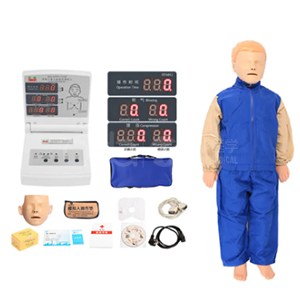
Product Line | BIX CPR Training Manikins (CPR100A / CPR100D / CPR480 / CPR160A / CPR170) |
Summary | AHA-compliant CPR training manikins for every age group: adult half-body ( |
Coverage | Adult, pediatric, neonatal |
Feedback | Mechanical clicker to electronic assessment |
Application | BLS certification, PALS, NRP, institutional training |
Cardiac arrest kills more people than most other emergencies combined. In the United States alone, more than 350,000 out-of-hospital cardiac arrests occur annually, and survival depends on two factors: early recognition and immediate, high-quality CPR (Meaney et al., 2013).
The chain of survival is time-critical. For every minute without CPR, survival decreases by 7–10%. Bystander CPR doubles to triples survival rates compared to no CPR before emergency services arrive. The seven steps below — aligned with the AHA 2020 Guidelines for CPR and ECC — are the standardized sequence that gives a victim the best chance.
Important note on the order: The AHA 2020 Guidelines emphasize the C-A-B sequence — compressions first, then airway, then breathing — to minimize time to first compression. The 7 steps below follow the commonly taught DRS-ABCD progression while embedding the C-A-B priority: after scene safety and checking, the rescuer moves quickly through airway and breathing checks to deliver compressions within seconds.
Scene safety:
● Confirm the environment is safe for both rescuer and victim. Move the victim only if necessary.
Responsiveness:
● Tap the shoulders and shout. Check for any response. If the victim is unresponsive, proceed immediately.
Time target: under 10 seconds.
● Activate the emergency response system (call 911, 112, or local EMS number).
● If others are present, assign a specific person: "You — call emergency services and get the AED."
● If alone, call before starting compressions (adult protocol); for children and infants, provide 2 minutes of CPR first, then call (Wyckoff et al., 2015).
● Place the victim supine on a firm surface.
● Use the
head-tilt/chin-lift maneuver
: one hand on the forehead, fingers of the other hand under the chin, tilt the head back and lift the chin.
● For suspected trauma: use the jaw-thrust maneuver instead to avoid cervical spine movement.
● Look, listen, and feel for normal breathing for
no more than 10 seconds
.
● Agonal gasps are not normal breathing — they are a sign of cardiac arrest.
● If not breathing normally, begin compressions immediately.
Position:
● Heel of one hand on the lower half of the sternum, other hand on top, fingers interlocked.
Depth:
● 5–6 cm (at least 2 inches, no more than 2.4 inches) — compression depth is the single most predictive mechanical parameter of survival.
Rate:
● 100–120 compressions per minute.
Recoil:
● Allow full chest recoil between compressions — leaning reduces coronary perfusion.
Research from the Resuscitation Outcomes Consortium analysis of 3,098 cardiac arrests found compressions within the 5–6 cm depth range produced a 23% higher rate of return of spontaneous circulation (ROSC) than shallow compressions (Idris et al., 2015).
● After 30 compressions, open the airway again and give 2 rescue breaths, each over 1 second, watching for chest rise.
● Use a barrier device (pocket mask or face shield) if available.
Avoid over-ventilation:
● excessive tidal volume or force causes gastric insufflation and regurgitation — a documented complication that reduces survival (Aufderheide et al., 2004).
● Continue cycles of 30 compressions : 2 breaths. Rotate compressors every 2 minutes to prevent fatigue-related depth decay (Meaney et al., 2013).
● Turn on the AED and follow voice prompts.
● Attach pads to the bare chest as diagrammed.
Clear the victim
● before rhythm analysis and before delivering a shock.
● Resume compressions immediately after the shock for another 2 minutes before re-analyzing.
Early defibrillation within 3–5 minutes of collapse raises survival to 50–70%.
The 7-step sequence is universal — the numbers are not.
Age Group | Compression:Ventilation | Compression Depth | Notes |
Adult | 30:2 (single and two rescuers) | 5–6 cm | Two-thumb technique not applicable |
Child (1 year to puberty) | 30:2 single / 15:2 two rescuers | One-third AP diameter (~5 cm) | Two-rescuer ratio differs from adult |
Infant (under 1 year) | 30:2 single / 15:2 two rescuers | One-third AP diameter (~4 cm) | Two-finger or two-thumb technique |
Neonate (newborn) | 3:1 | One-third AP diameter | Ventilation priority; 3:1 ratio unique to neonatal |
The most dangerous training error is applying adult 30:2 muscle memory to a newborn — the ratio differs by a factor of ten. Age-appropriate training models prevent this transfer error (Wyckoff et al., 2015).
CPR skills decay within 3–6 months without practice (Bhanji et al., 2015). Training is not a one-time event — it is a maintenance habit. Effective programs use:
Manikins with objective feedback.
1. Mechanical clicker models (confirm 5–6 cm depth) or electronic models (measure depth, rate, and ventilation) turn subjective practice into measurable performance. Electronic feedback training improves correct compression depth by up to 47% compared to passive practice (Cheng et al., 2015).
Age-appropriate models.
2. Adult, pediatric, and neonatal manikins enforce the different ratios and techniques described above.
Ratio drills.
3. Practice the 30:2, 15:2, and 3:1 transitions explicitly — students must be able to switch ratios without hesitation.
Full recoil emphasis.
4. Use a metronome or app to maintain 100–120/min and coach full chest recoil every cycle.
Chinon Medical manufactures AHA-compliant training manikins for every age group — from the $176 adult half-body model to the electronic assessment model — with mechanical and electronic feedback options. For institutional quotes and training support: ada-manikin@adaanatomy.com
Q1: What is the correct hand position for adult CPR? A: Place the heel of one hand on the lower half of the sternum (center of the chest, between the nipples), with the other hand on top, fingers interlocked. Compress vertically to 5–6 cm at 100–120 compressions per minute.
Q2: How many compressions per minute? A: 100–120 compressions per minute for all age groups. Rates above 120 reduce coronary perfusion; rates below 100 fail to maintain adequate circulation (Idris et al., 2015).
Q3: What is the compression-to-breath ratio for children? A: 30:2 for single rescuer, 15:2 for two rescuers (child and infant). For newborns, the ratio is 3:1. This is the most common ratio confusion in training — age-specific manikins prevent it.
Q4: Do I really need to give rescue breaths, or is hands-only CPR enough? A: The AHA recommends hands-only CPR (compressions only) for untrained bystanders. Trained rescuers should provide compressions with rescue breaths. For children and infants, rescue breaths are essential because arrests are predominantly respiratory.
Q5: What if I do CPR wrong? A: Any CPR is better than no CPR. The AHA estimates that even imperfect compressions double survival chances compared to no intervention. Objective-feedback training manikins reduce the margin of error before you face a real victim.
Q6: How often should CPR skills be refreshed? A: AHA guidelines recommend recertification every 2 years, but skill research shows decay within 3–6 months — quarterly practice sessions are the evidence-based recommendation. For training equipment and consumables: ada-manikin@adaanatomy.com
AHA 2020 Guidelines for CPR and ECC
CPR Quality: Improving Cardiac Resuscitation Outcomes — Meaney et al. (2013)
Compression Rate and Depth Outcomes — Idris et al. (2015)
Hyperventilation During CPR — Aufderheide et al. (2004)
Part 14: Education — AHA Guidelines — Bhanji et al. (2015)
Neonatal Resuscitation Guidelines — Wyckoff et al. (2015)
Feedback-Based CPR Training — Cheng et al. (2015)







Leave a comment: