
Welcome to visit ADA MED SUPPLY LIMITED
Phone:+86 13383897707
Email:ada-manikin@adaanatomy.com
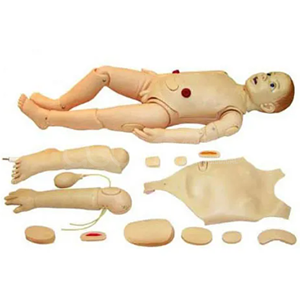
The BIX-FT433 is a three-year-old child care simulation manikin built around paediatric proportions and paediatric tasks: airway, feeding, injection, enema and holistic care. It is priced on quotation rather than a list price, which means the buyer carries more of the specification burden. This checklist is the one to bring to that conversation.
Quick answer: FT433 is a three-year-old child nursing manikin with pupils, airway management, oral/nasal feeding, gastric lavage, arm venous access with flashback, three IM sites, enema and full-body care. Price on quotation. Confirm spare parts, skin replacements and airway consumables before ordering.
The product page groups the functions clearly:
| Domain | FT433 functions | What to test in a demo |
|---|---|---|
| Observation | Simulated bilateral pupils, normal and dilated | Pupil contrast under room light |
| Hygiene and care | Bathing, dressing, hair combing, eye/ear cleaning, oral care | Skin tolerance to repeated dressing |
| Diagnostics | Finger blood collection, TB test | Site durability after 50 punctures |
| Airway | Oral intubation, suction, oxygen, realistic mouth/nose/tongue/pharynx/larynx/epiglottis/trachea | Intubation feel and suction depth |
| Feeding | Oral and nasal feeding, gastric lavage | Tube resistance and fluid return |
| Circulation | Arm venipuncture/injection/infusion with flashback | Flashback reliability at low pressure |
| Injection | Deltoid, quadriceps lateralis, buttocks | Pad replacement access |
| Elimination | Enema, rectal plug for catheterisation | Cleanout time between learners |
| Holistic | Wiping, changing clothes, cold and hot therapy | Joint range and limb attachment |
| Access and assessment | Tibial bone marrow puncture with simulated marrow; auscultation of heart, breath and bowel sounds | Emergency access plus confirmation |
| Anatomy | Ileum, colon and bladder fistula care | Stoma and fistula routines |
Bowling and colleagues, writing in the Journal of Pediatric Nursing (2015), argue that paediatric nursing education needs a deliberate change in how simulation is used, not simply more hours. Holmes's 2024 conceptual review in Clinical Simulation in Nursing makes a related point: acute paediatric simulation should be designed around the child's developmental stage. A three-year-old is not a small adult — the airway is proportionally different, the chest wall is more compliant, and the child's ability to cooperate is limited. A manikin built to three-year-old proportions encodes those differences in a way an adult trainer cannot.
Austin's work on paediatric disaster simulation (2013) adds a useful scenario layer: children in a mass-casualty exercise require different triage and different handling. FT433 can carry the skills portion of that scenario, though not the disaster context itself.
| Item | Quantity per station | Note |
|---|---|---|
| FT433 manikin | 1 | Core unit |
| Venipuncture pad set | 1 spare | Highest-wear item |
| IM injection pads | 1 spare set | Three sites, check availability |
| Feeding tube and syringe | 2 sets | One per learner pair |
| Rectal plugs | 2 | Enema practice |
| Child-size clothing | 2 sets | Dressing and dignity training |
Ask the supplier to quote the station as a bundle. A manikin quoted without consumables is not a usable station, and the difference shows up three weeks into term. Send the station list to ada-manikin@adaanatomy.com.
No CPR feedback, no defibrillation, no ECG, no IV pump interface, and no programmable deterioration. The airway is anatomical, not electronic. If your programme needs a deteriorating-child scenario with vital-sign changes, FT433 is the skills station, not the scenario engine.
Q1. What age does the manikin represent? Three years old, based on anatomical features of a three-year-old child.
Q2. Is the price fixed? No. It is quoted on request and depends on configuration, quantity and freight.
Q3. Can it be used for CPR training? CPR is not listed among its functions. Use a dedicated paediatric CPR manikin.
Q4. Does arm access give blood flashback? Yes. The page describes a clear emptying sensation and blood return on successful puncture.
Q5. Are the pupils adjustable? The model provides normal and dilated pupils for contrast observation; they are not dynamically adjustable.
Q6. Can it be used for enema practice? Yes, including rectal plugs for catheterisation practice.
Price: quotation required. Product page: BIX-FT433 three-year-old child nursing manikin. Catalogue: nursing models. More buyer guides: news.
Station bundles and spare-part pricing: ada-manikin@adaanatomy.com.






Leave a comment: