
Welcome to visit ADA MED SUPPLY LIMITED
Phone:+86 13383897707
Email:ada-manikin@adaanatomy.com
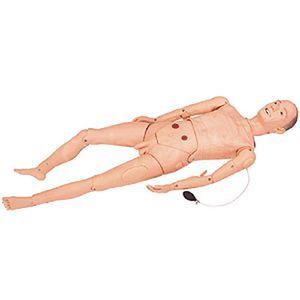
The BIX-H220A is a full-body elderly male manikin with 27 listed basic nursing functions, from hair washing to colostomy care, plus stiffened joints designed to mimic age-related restriction. At US $648.12 it sits in the middle of the nursing-manikin market, where the real question is not how many functions are printed on the spec sheet but how many a cohort will actually use in a term.
Quick answer: H220A is an elderly male nursing manikin in imported PVC with 27 basic nursing functions, including intubation with sensor feedback, catheterisation, enema, stoma care, pressure-ulcer care and prostate examination. Reference price US $648.12. Best for geriatric nursing skills labs, not for CPR or childbirth.
The page lists them as a flat numbered set. Grouped by teaching purpose, they read more usefully:
| Group | Functions included | Teaching use |
|---|---|---|
| Hygiene and comfort | Hair/face wash, eye and ear care, oral and denture care, hearing-aid insertion | Morning-care routines, dignity in care |
| Airway and breathing | Endotracheal intubation with sensor, tracheotomy care, suction, oxygen | Airway station with objective intubation check |
| Feeding | Oral and nasal feeding, gastric lavage | Tube placement and verification |
| Injection and infusion | Arm venipuncture/infusion, deltoid subcutaneous, vastus lateralis, buttock IM | Four injection sites on one body |
| Drainage and elimination | Enema, urethral catheterisation, bladder injection, stoma drainage, colostomy | Continence and stoma care |
| Assessment | Pupil states, thoracic/abdominal/liver/marrow/lumbar puncture, prostate exam, sacral ulcer, tumour and cleavage-line contrast | Advanced assessment and palpation |
| Mobility | Stiffened joints, trunk forward lean, wheelchair sitting | Safe transfer and positioning |
Most mid-range manikins let a learner intubate; few tell them whether the tube went into the oesophagus. The H220A page specifies automatic monitoring of intubation correctness through a sensor, plus auscultation to confirm placement. That single feature changes a station from "watch me do it" to "try it and find out," which is the difference between demonstration and practice.
A practical station: two attempts per learner, one deliberate oesophageal intubation followed by auscultation, then a correct placement. Learners who have heard the wrong side once rarely forget it.
The description states realistic limb joints with "stiff simulated joints," trunk forward lean, and the ability to sit in a wheelchair. For geriatric care this is the right choice — a limber 25-year-old manikin teaches the wrong transfer technique. The caveat is maintenance: stiff joints take more force, and force applied at the shoulder or hip repeatedly will shorten the manikin's life. Teach learners to support the limb, not to pull it.
Yue's multi-centre study of geriatric nursing competence (Geriatric Nursing, 2025) and Díaz's framework for integrating healthy-ageing indicators into nursing education (2026) both stress that geriatric competence is about function and dignity, not just task completion. A manikin with restricted joints supports that framing better than a fully articulated one.
Imported PVC, washable, with a large sacral ulcer simulated for staging practice. Clean with mild detergent; avoid alcohol on painted areas. The sacral ulcer is a moulded feature, not a replaceable wound module — check with the supplier whether replacement skins are available if your programme stages wounds repeatedly with dressings and adhesives.
No CPR feedback, no defibrillation, no ECG, no childbirth, no paediatric modes. If your curriculum needs those, this is the wrong model and you should be looking at an emergency-series simulator instead. Buying one manikin to do everything usually produces a manikin that does nothing well.
At US $648.12 reference, the manikin is the cheap part. Budget for: catheterisation consumables, feeding tubes, dressings for the sacral ulcer, and replacement arm skins if venipuncture is taught heavily. Ask the supplier for a spare-parts list with unit prices before you commit to a cohort of ten. That request goes to ada-manikin@adaanatomy.com.
Q1. Is the manikin male or female? Male, designed as an elderly adult, and includes prostate examination with foreskin.
Q2. Does intubation give feedback? Yes. A sensor monitors whether tracheal intubation is correct, and auscultation can be used to confirm placement.
Q3. Can it be used for CPR? No. CPR, defibrillation and ECG are not listed functions.
Q4. Can it sit in a wheelchair? Yes. The trunk can lean forward and the joints are designed for supported sitting.
Q5. Are replacement parts available? Not stated on the page. Request a spare-parts price list with the quotation.
Q6. What is the price? US $648.12 reference per unit, quantity-dependent, freight additional.
Reference price: US $648.12. Product page: BIX-H220A elderly male nursing manikin. Catalogue: nursing models. More reviews: news.
Spare skins, consumables and cohort pricing: ada-manikin@adaanatomy.com.






Leave a comment: