
Welcome to visit ADA MED SUPPLY LIMITED
Phone:+86 13383897707
Email:ada-manikin@adaanatomy.com
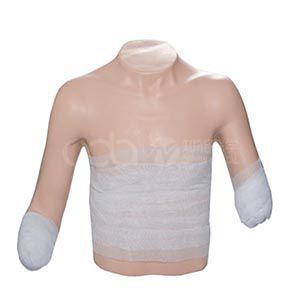
The BIX-LV13 is a female bandaging and fracture-fixation trainer: torso and head modelled down to the iliac spine, a movable right arm, an amputated left arm above the elbow, and a cut right index finger for stump and digit bandaging. It ships with one bandage and one triangular bandage, and the page price is US $324.06. It is a bandaging model, not a wound-care or suture model.
Quick answer. The LV13 is worth buying if your programme teaches the full bandage repertoire — annular, spiral, spiral reverse, figure-of-eight and recurrent — plus fracture fixation, and needs a body that allows all of them in one sitting. It is not worth buying if your syllabus stops at a single limb bandage, because a limb trainer costs a fraction of this.
| Item | Specification | Teaching consequence |
|---|---|---|
| Model | BIX-LV13 senior high-order bind-up model | Whole-body bandaging in one station |
| Extent | Head, neck, torso to the iliac spine | Head, jaw, breast and chest bandages are all possible |
| Right arm | Movable shoulder, elbow and wrist; cut index finger | Joint positions can be set before bandaging; digit stump practice |
| Left arm | Amputation above the elbow | Stump bandaging with realistic taper |
| Fracture sites | Clavicle, forearm, humerus | Fixation and sling technique on the same model |
| Reference price | US $324.06 | One purchase replaces several limb-only trainers |
The value of the LV13 is breadth. A single model covers the bandage types that are normally spread across a head block, a chest block and two arm trainers.
The failure mode for bandaging trainers is not breakage — it is loss of shape. Foam limbs compress at the wrap line after a few dozen students, and the bandage then slides because the taper has flattened. The LV13 is built as a body shell rather than a foam cylinder, so the taper at the amputation and the contour at the iliac spine stay constant.
Two design details matter for assessment. The movable right arm lets the examiner set a joint angle and ask the student to bandage without moving it — a rule that separates technique from repositioning. The cut index finger allows a digit bandage to be assessed for tension, which is where circulation compromise is actually caused.
Bandaging competence is not a one-off check. Studies of lower-limb bandaging among nurses found that technique and the pressure applied varied widely and improved with structured training, and reviews of compression bandaging stress that the type of bandage and the skill of application determine the outcome as much as the product.[1][2] Simulation-based teaching has been shown to change technique scores in comparable psychomotor skills.[3]
The practical consequence for a school: bandaging needs a station that can be reset in under a minute and used by a whole cohort. That is the specification the LV13 is built to.
Email ada-manikin@adaanatomy.com for bandage pack sizes, the arm joint range and a photograph of the amputation stump finish.
| Field | Value on the product page |
|---|---|
| Product number | BIX-LV13 |
| Category | Clinical models |
| Extent | Head, neck, torso to iliac spine; right arm with joints; left arm amputated above elbow |
| Included | One bandage, one triangular bandage |
| Reference price | US $324.06 |
| Certification | ISO 9001, ISO 14001, ISO 45001 factory certification |
Q1. Is the LV13 a full body? It models the head, neck and torso down to the iliac spine, with a right arm that has movable shoulder, elbow and wrist joints and a left arm amputated above the elbow. It has no lower limbs.
Q2. Which bandage types are supported? Annular, oblique, spiral, spiral-reverse, figure-of-eight and recurrent bandages, plus head, eye, ear, jaw, breast and chest bandages.
Q3. Can it be used for fracture fixation? Yes. The clavicle, forearm and humerus can be fixed, and sling technique can be practised.
Q4. Does it come with bandages? One bandage and one triangular bandage are included; extras should be ordered with the model.
Q5. What is the reference price? US $324.06 per unit before freight, subject to confirmation at the time of order.
Q6. Can it teach wound dressing? No. The model has no wounds or bleeding, so it is limited to bandaging and fixation.
Contact. For bandage pack sizes, joint range data or a school quotation, email ada-manikin@adaanatomy.com. Product page: https://www.ada-manikin.com/clinical-models/high-order-bind-up-model-LV13 · Clinical models: https://www.ada-manikin.com/clinical-models · All articles: https://www.ada-manikin.com/neslist.html






Leave a comment: