
Welcome to visit ADA MED SUPPLY LIMITED
Phone:+86 13383897707
Email:ada-manikin@adaanatomy.com
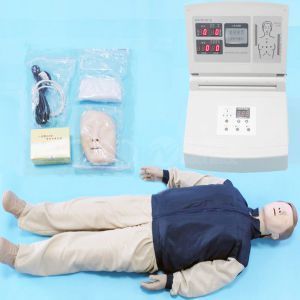
The BIX/CPR490 is a full-body adult CPR simulator with three operating modes — training, standard assessment and instructor-set assessment — electronic counting of correct and incorrect compressions and breaths, barcode-based ventilation volume display, and printed reports.
Quick answer. The CPR490 is a scoring simulator for programmes that must document competence, not just let students practise. It is the right purchase if you run certified courses with 30:2, five-cycle assessments. It is over-specified if you only need basic compression practice.
| Item | CPR490 | Why a buyer should care |
|---|---|---|
| Body | Full-body adult with airway, pupils, carotid pulse | Full scenario, not a torso |
| Modes | Training, standard assessment, custom assessment | Separates learning from testing |
| Standard | 30:2, five cycles, 2020 international CPR standard | Matches AHA-aligned course design |
| Feedback | Correct/incorrect compression and breath counts | Objective score, less instructor drift |
| Ventilation | Barcode display of blowing volume | Detects over-ventilation |
| Output | Printed report | Evidence for course records |
| Airway | Head tilt, airway indicator light | Teaches opening before ventilation |
AHA 2020 guidance sets compression rate at 100–120 per minute, depth of at least 5 cm but no more than 6 cm in an average adult, full chest recoil between compressions, and interruptions kept short. Any simulator you buy should score those four things separately.
The CPR490 counts correct and incorrect actions and runs a five-cycle 30:2 assessment within a set time. That maps to the four numbers, but not perfectly: it reports counts and timing rather than a depth curve. If your course requires depth-versus-time graphs for debriefing, ask the supplier for the report sample before you buy.
A CPR simulator has three cost layers: the unit, the consumables (lungs, face skins, airway seals) and instructor time. Consumables scale with student numbers, so the cheapest unit can become the most expensive programme if a face skin lasts 50 students instead of 200.
Ask two questions in writing: how many students a face skin typically serves, and what a replacement lung set costs. Multiply by your annual cohort. That number, not the quote, is the budget line.
If your course includes AED use or team-based advanced life support, budget a second trainer rather than expecting one unit to cover it.
Q1. What modes does the CPR490 have? Training, standard mode assessment and instructor-set assessment.
Q2. Does it follow AHA 2020? It is built around the 2020 international CPR standard with 30:2 and five cycles. Confirm the exact protocol in the manual before purchase.
Q3. Does it print results? Yes, it produces printed reports for assessment records.
Q4. Does it measure ventilation volume? It displays blowing volume through a barcode indicator; confirm the range with the supplier.
Q5. Is it full-body? Yes, full-body adult with airway, pupils and carotid pulse.
Q6. What is the price? Quote-based. Request unit price, consumable pricing and freight in one quotation.
Related on this site: medical first aid model collection · all articles
Contact. For a sample report, consumable pricing or a station-layout quote, email ada-manikin@adaanatomy.com.






Leave a comment: