Welcome to visit ADA MED SUPPLY LIMITED
Phone:+86 13383897707
Email:ada-manikin@adaanatomy.com
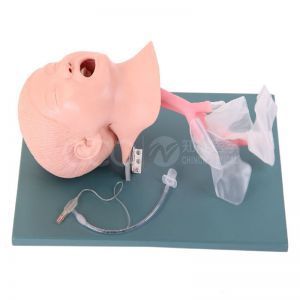

Airway training is usually organised by procedure, not by age. That is a mistake. The same tube-passing motion meets a different anatomy at every stage of childhood, and a trainee who has only practised on a newborn will misjudge the older child's larynx — not because the technique is wrong, but because the landmarks have moved.
The BIX-J4A is a child-sized airway intubation training head with paediatric landmarks. This comparison sets out what changes with age, what the J4A specifically trains, and how a department should budget for age-specific heads rather than one generic trainer.
| Structure | Neonate | Infant | Child | Training consequence |
|---|---|---|---|---|
| Head size | Large relative to body | Still proportionally large | Closer to adult proportion | Positioning aids change with age |
| Larynx position | High, anterior | Descending | Lower, closer to adult | The view changes; blade technique must adapt |
| Epiglottis | Soft, U-shaped, angled | Softer, still angled | Firmer, more adult-like | Straight versus curved blade decisions |
| Narrowest point | Cricoid ring | Cricoid ring | Gradually toward glottis | Tube sizing risk shifts |
| Tongue | Relatively large | Large | Proportionally smaller | Space at the laryngoscope tip differs |
| Airway calibre | Smallest | Small | Larger | Margin for oedema differs sharply |
These are not academic distinctions. A tube that passes easily in a child may be too large for an infant, and a blade that lifts the infant epiglottis may lever on the child's teeth. Age-specific heads exist because the hand needs to meet each anatomy before the clinician meets a patient.
Reference price on the product page is $176.74, subject to order quantity.
Deliberate practice with repetition and specific feedback is the instructional pattern most consistently linked to skill retention [1]. A single successful attempt per trainee is not practice; it is a demonstration.
State these limits in the course outline. Trainees who assume a manikin pass equals clinical readiness are the ones who hesitate in a real paediatric emergency.
A department that teaches paediatric airway skills needs at least a child and a neonate head; an infant head is a useful third. Buying one generic "paediatric" trainer and expecting it to cover all ages is the false economy — the anatomy it teaches is only one of three.
Ask the supplier for a set quotation with shared consumables, and factor replacement teeth and airway parts into the annual budget. The consumable cost, not the purchase price, determines the real cost per trainee.
Quotation and specification. Current pricing, spare parts and course-set options for the BIX-J4A are available from ada-manikin@adaanatomy.com.
Q1. What age group does the BIX-J4A represent? A child, with child-sized anatomical landmarks for intubation practice.
Q2. Can it be used for newborn training? No. Neonatal anatomy differs enough that a dedicated neonate head is required.
Q3. Is the J4A a full-body manikin? No. It is an intubation head for airway skills.
Q4. What is the reference price? $176.74 on the product page, subject to order quantity.
Q5. What consumables does it need? Paediatric tubes, a suitable laryngoscope blade, suction and lubricant. Confirm the tube range with the supplier.
Q6. How many heads does a course need? One head per two trainees at a station keeps waiting time short; a set of child and neonate heads covers the common course mix.
Product page: Why Child-Sized Landmarks Matter: BIX-J4A in Paediatric Airway Training — specification, packing data and a quotation request form.
For a quotation on the BIX-J4A, or a child-plus-neonate course set, write to ada-manikin@adaanatomy.com with the age groups your faculty teaches.






Leave a comment: