
Welcome to visit ADA MED SUPPLY LIMITED
Phone:+86 13383897707
Email:ada-manikin@adaanatomy.com
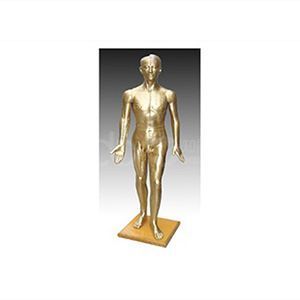
A meridian chart shows a line. A patient presents a body, and the distance between two points changes with the width of the ribcage and the length of the limb. The bronze man model exists to close that gap, and it has done so since the Ming dynasty teaching figures that gave the format its name. BIX-Y1002 is a 178 cm fibreglass model: 14 primary channels and 361 acupoints with 48 extraordinary points on the right side, CUN markers for judging inter-point distance, and a subcutaneous view of nerves, arteries, veins and muscles on the left. Listed price is US $471.42.
| Item | Detail |
|---|---|
| Model | BIX-Y1002 |
| Height | 178 cm, life-size proportion |
| Material | Fibreglass |
| Right side | 14 primary channels, 361 acupoints, 48 extraordinary acupoints, CUN markers |
| Left side | Subcutaneous view: neural distribution, arteries, veins, blood vessels, muscle structure |
| Additional | Upper and lower extremity extra points not on the primary channels |
| Finish | High-simulation muscle material; resistant to cracking and discolouration; clear lettering |
| Price | US $471.42 |
Teaching acupuncture on a one-sided model produces a specific blind spot: students learn where a point is but not what sits underneath it. The left side of BIX-Y1002 shows nerves, vessels and muscle; the right side shows channels and points. A student can therefore be asked to locate a point and then say what structure lies deep to it — a question that separates memorisation from understanding, and the one that matters when needling depth is discussed.
The CUN markers do the second job. Point location is proportional, not absolute, and a marker set lets an instructor ask "how many cun from the umbilicus" instead of "how many centimetres", which is the way the classical texts and modern examination both phrase it.
Teach by channel, not by number. Fourteen channels divide the point set into teachable blocks of roughly 9 to 67 points. A term of sixteen sessions can cover one channel per session with revision built in.
Separate the two categories early. The 48 extraordinary points are not on the channels and are examined differently. Mixing them into channel teaching is the most common cause of confusion in first-year cohorts.
Anchor each channel to a landmark. Lung channel to the radial artery, stomach channel to the mid-clavicular line, and so on. Once the landmark is fixed, point order becomes memorable.
Physical models outperform three-dimensional computer models and textbooks for learning spatial anatomy in a controlled comparison [1], and reviews of anatomy teaching consistently find that handling a physical object improves retention of spatial relationships [2]. Competency-based acupuncture curricula place point location under direct observation, which requires an object a student can be observed on [3].
Quotation and freight. Current pricing, crate dimensions and delivery terms for BIX-Y1002 are available from ada-manikin@adaanatomy.com.
Q1. How many points are marked on BIX-Y1002? 361 acupoints along the 14 primary channels plus 48 extraordinary acupoints on the right side.
Q2. What is shown on the left side? A subcutaneous view: neural distribution, arteries, veins, blood vessels and muscular structures, plus upper and lower extremity extra points.
Q3. What are the CUN markers for? They let instructors teach proportional point location — distance measured in cun rather than centimetres.
Q4. What is the model made of? Fibreglass, described by the manufacturer as resistant to cracking and discolouration, with clear, durable lettering.
Q5. Can students practise needling on it? No. It is a display and location model; needling depth requires a practice pad or cadaver material.
Q6. What is the price? US $471.42 as listed, with freight quoted separately by destination.
For a quotation on BIX-Y1002 with crating and freight to your city, write to ada-manikin@adaanatomy.com with the room dimensions and the label language you need.






Leave a comment: