Welcome to visit ADA MED SUPPLY LIMITED
Phone:+86 13383897707
Email:ada-manikin@adaanatomy.com
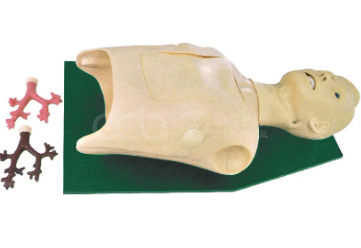
A bronchoscopy trainer earns its price when the session forces the trainee to confirm tube position twice — once by image, once by auscultation — because that double check is what prevents the commonest avoidable error in the intensive care unit. BIX-LV44 is an adult upper-body model priced at a reference $824.88, with a soft nasal cavity, an elastic tracheobronchial tree, a head that tilts and rotates, a tooth-pressure alarm for wrong handling, and enough acoustic realism for lung auscultation to confirm catheter position. It supports fibreoptic bronchoscopy, rigid bronchoscopy and tracheal tube intubation. This guide gives a 90-minute session design that uses all four capabilities.
| Item | Detail |
|---|---|
| Model | BIX-LV44 |
| Type | Bronchoendoscope training model, adult upper body |
| Reference price | $824.88 (subject to order quantity) |
| Airway | Soft nasal cavity, elastic and flexible trachea and bronchial tree |
| Positioning | Head can be tilted back and rotated to the position required |
| Safety cue | Alarm when the teeth are pressed too hard |
| Confirmation | Lung auscultation to determine catheter position |
| Procedures | Fibreoptic bronchoscopy, rigid bronchoscopy, tracheal tube intubation |
| Certification | ISO 9001, ISO 14001 and ISO 45001 (as listed) |
Set the head position deliberately. The listing notes that the head tilts backwards and swings side to side; that movement is the point of the model, because the operator has to learn to adjust the head instead of forcing the scope. Start every session with the head in a neutral position and require the trainee to reposition it themselves.
Decide the route in advance. Nasal and oral approaches teach different hand-eye problems. The soft nasal cavity makes the nasal route realistic, and a class that only ever practises orally will struggle on the ward, where the nasal route is often preferred in a conscious patient [1].
Test the alarm before teaching with it. The tooth-pressure alarm is the model's built-in correction: it fires when the operator levers the scope against the teeth. Confirm it works, then tell trainees explicitly that the alarm is a teaching cue, not a fault, so nobody freezes when it sounds.
Strong on: scope handling, route selection, head positioning, recognition of the carina and main bronchi, tube depth confirmation by auscultation, and the habit of checking for excessive force.
Weaker on: bleeding, secretions and mucosal abnormality. There is no described facility for simulating haemorrhage or tumour, so therapeutic bronchoscopy and complication management need a different platform or a supervised clinical setting.
Not a substitute for: sedation and airway decision-making, which belong in simulation with a team, and for the cognitive steps of consent and indication. Simulation-based bronchoscopy programmes work best when they are embedded in a curriculum with governance and assessment rather than run as one-off workshops [3].
Documentation and quotation. The specification, accessory list and current price for BIX-LV44 are available from ada-manikin@adaanatomy.com.
Q1. What procedures does BIX-LV44 support? Fibreoptic bronchoscopy, rigid bronchoscopy and intubation through a tracheal tube, with auscultation used to confirm catheter position.
Q2. Does it have a feedback mechanism? Yes, an alarm sounds when the teeth are pressed too hard, which flags excessive levering during insertion.
Q3. Can the head be repositioned? Yes. The head tilts backwards and swings side to side so the operator can set the position needed for the procedure.
Q4. Is the airway replaceable? The airway is described as elastic and flexible; ask the supplier whether replacement airway parts are available as consumables.
Q5. What is the price? The reference unit price is $824.88, subject to order quantity and freight.
Q6. Suitable for which trainees? Junior doctors, respiratory trainees, ICU and anaesthesia staff learning scope handling, and nursing staff practising tube depth confirmation.
For a quotation on BIX-LV44, including scope compatibility and spare airway parts, write to ada-manikin@adaanatomy.com with your training programme and scope sizes.






Leave a comment: