Welcome to visit ADA MED SUPPLY LIMITED
Phone:+86 13383897707
Email:ada-manikin@adaanatomy.com
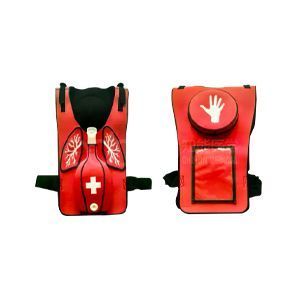
Choking first aid is usually taught on a torso manikin lying on a table, which is not how choking happens. The BIX-H606 takes a different route: a wearable adult vest in diving fabric, 1.2 kg, with a foreign-body plug, so a trainee can practise abdominal thrusts on a standing or seated partner and feel the plug eject. For workplaces, restaurants and school staff training, that change of posture is the main argument for the product.
| Item | Detail |
|---|---|
| Model | BIX-H606 |
| Type | Wearable adult Heimlich training vest |
| Material | Diving fabric |
| Net weight | 1.2 kg |
| Accessories | 1 wearable vest, 1 foreign-body plug |
| Postures | Standing or seated; can be used with a chair, table or counter |
| Feedback | Foreign-body plug ejection when thrusts are effective |
| Certification | ISO 9001 / 14001 / 45001 and CE (as stated on the product page) |
| Price | Quoted per order |
Height and access. Abdominal thrusts must be applied above the navel and below the xiphoid process, with the rescuer standing behind and slightly to one side. On a table-top manikin, students kneel and the geometry is wrong. On a vest worn by a colleague, the rescuer has to solve the real problem: where to stand, how to reach around, how to adjust for a taller or shorter casualty.
Consent and contact. Teaching choking response requires physical contact near the abdomen and lower chest. A vest gives a clear boundary and a repeatable target, which matters in workplace training where colleagues practise on each other.
The plug is the feedback. A thrust that is too low, too shallow or directed at the wrong depth will not eject the plug. That single mechanical consequence teaches more than a verbal correction, and it is the reason the accessory is central rather than optional.
Seated scenarios are included. Choking at a desk or in a restaurant is common, and a seated casualty changes the rescuer's approach. The vest can be used standing or seated, with a chair or table, which allows a scenario rather than a drill.
Documentation and quotation. Packing data, certificates and current pricing for the BIX-H606 are available in writing from ada-manikin@adaanatomy.com before you place the order.
Q1. How is the BIX-H606 different from a choking manikin? It is worn by a person, so the rescuer practises on a standing or seated body at real height, with a foreign-body plug that ejects when thrusts are effective.
Q2. Does it work for self-rescue practice? Yes. The vest can be used to rehearse self-rescue against a chair or counter edge, which is the situation most trainees have never practised.
Q3. Is it suitable for children? No. It is an adult training vest. Paediatric choking requires a paediatric trainer and a different technique.
Q4. How much does it weigh? 1.2 kg net, which is light enough for a colleague to wear through a session.
Q5. What certifications does it carry? The product page states ISO 9001, ISO 14001, ISO 45001 and CE. Ask for the certificates that your procurement office requires.
Q6. What is included? One wearable Heimlich training vest and one foreign-body plug.
For a quotation on the BIX-H606, spare foreign-body plugs and a multi-vest workplace set, write to ada-manikin@adaanatomy.com with your group size and the settings you train.






Leave a comment: