Welcome to visit ADA MED SUPPLY LIMITED
Phone:+86 13383897707
Email:ada-manikin@adaanatomy.com
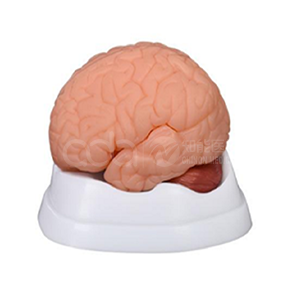
Short answer: ADA-304B is a life-size brain model that dissects into nine parts and sits on a stand. The product page publishes the external features it demonstrates — cerebral hemisphere, brain stem and cerebellum — its dimensions (18.5 x 14 x 13.5 cm) and a reference unit price of US $32.42, subject to order quantity. It does not publish a part-by-part list, the material, or the weight, so the nine-part claim should be confirmed in writing before a bulk order.
Key takeaways
| Item | Published detail |
|---|---|
| Model | ADA-304B |
| Product name on page | New Style Brain Model 9 Parts — Life-Size Human Brain Anatomy Model |
| Category path | Anatomical Series → Brain Models |
| Dissection | 9 parts |
| Scale | Life-size |
| Dimensions | 18.5 x 14 x 13.5 cm |
| Mounting | On stand |
| Reference unit price | US $32.42 — subject to order quantity |
| Certification | ISO & CE (stated on page) |
| Task you can set | 3-part model | 9-part model (ADA-304B) |
|---|---|---|
| Name the three external divisions | Yes — the model is built around them | Yes, then reassemble to prove it |
| Hand a single lobe or segment to a student | Not possible; the piece is too large | Possible — smaller pieces pass round a group |
| Ask a group to rebuild the brain in order | Trivial with three pieces | A genuine spatial task with a wrong-answer state |
| Show internal relationships by removing one part | Limited | Nine removal points, each exposing a different relationship |
| Run a timed identification test | Low discrimination | Higher discrimination because more parts can be misplaced |
The point is not that more parts are always better. It is that segmentation sets the ceiling on the questions you can ask. A three-part brain supports a lecture; a nine-part brain supports an assessment.
Neuroanatomy teaching has been moving toward digital and printed alternatives, and the evidence is worth reading before you buy either. A 2026 study in the Journal of Educational Evaluation for Health Professions implemented low-cost 3D-printed brain colouring activities in neuroanatomy teaching — the intervention was cheap, physical and active [1]. A second paper in Anatomical Sciences Education described next-generation open-access visualisation of neuroanatomy through 3D modelling [2]. A third, in Annals of Anatomy, analysed how teaching anatomy in a clinical context affects dental students [3]. All three treat the physical or spatial object as the variable that matters — which is the argument for a desk-sized model rather than a slide.
Practically: a 9-part model at 18.5 cm fits on a seminar table, can be passed around, and can be reassembled incorrectly — which is the moment teaching happens.
| Question | Why it matters |
|---|---|
| What are the nine parts, exactly? | The page names three external features but does not list nine pieces; confirm the breakdown against your syllabus. |
| Material and finish | Decides whether the model survives handling and cleaning in a shared lab. |
| Weight and carton quantity | Not published; needed for freight on class-sized orders. |
| Price at 10, 50, 200 units | The published figure is a reference unit price subject to quantity. |
| Spare parts | A single lost hemisphere should not retire the model. |
Send those five lines to ada-manikin@adaanatomy.com with model ADA-304B and your student numbers, and the reply can cover the part list and the volume price together.
Q1. What is ADA-304B?
A life-size human brain anatomy model that dissects into nine parts, mounted on a stand, in the Anatomical Series → Brain Models category.
Q2. How big is it?
18.5 x 14 x 13.5 cm, life-size.
Q3. What does it show?
The page names the cerebral hemisphere, brain stem and cerebellum as the external features demonstrated, and states the model is intended for understanding the correlation of brain parts.
Q4. Is the price fixed?
No. US $32.42 is published as a reference unit price, explicitly subject to order quantity.
Q5. Is it certified?
The page states ISO and CE certification.
Q6. How do I order or get a volume price?
Email ada-manikin@adaanatomy.com with model ADA-304B, quantity and destination.
Write to ada-manikin@adaanatomy.com for the nine-part breakdown, the material specification and a volume quotation on ADA-304B. If you teach both neuroanatomy and head-and-neck anatomy, mention it — the same series carries skull-and-brain combinations that share a stand design.






Leave a comment: