
Welcome to visit ADA MED SUPPLY LIMITED
Phone:+86 13383897707
Email:ada-manikin@adaanatomy.com
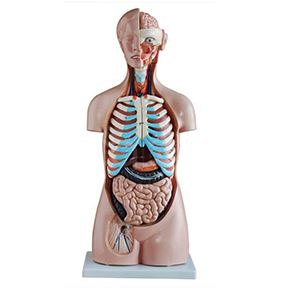
Short answer: ADA-206 is an 85 cm unisex — the page says sexless — human anatomy torso that separates into 20 parts, with an open back and a plastic base. The published parts list is specific: torso, head, eye, brain, lungs with sternum and rib attachments (2 parts), heart (2 parts), stomach (2 parts), liver, spleen, kidney, intestine (4 parts), urinary bladder and vertebra spinal nerves (2 parts). At 85 cm it is a demonstration-size unit, and the "sexless" specification is the decision that will either suit you or rule it out.
Key takeaways
| System | Published parts |
|---|---|
| Body wall | Torso, head |
| Nervous | Eye, brain, vertebra spinal nerves (2 parts) |
| Respiratory | Lungs with sternum and rib attachments (2 parts) |
| Cardiovascular | Heart (2 parts) |
| Digestive | Stomach (2 parts), liver, spleen, intestine (4 parts) |
| Urinary | Kidney, urinary bladder |
| Reproductive | Not supplied — the model is sexless |
Read as a coverage map, that list is strong on the digestive system (seven of the 20 parts) and complete on the major thoracic and abdominal organs. The gap is explicit and deliberate: no reproductive organs.
Before committing to an 85 cm unit, write to ada-manikin@adaanatomy.com quoting model ADA-206 and ask for the assembled height with base, the carton size and the material of the torso shell — all three affect whether it will live on a bench or in a cabinet.
| Limitation | Who it affects |
|---|---|
| No male or female genitalia | Any course covering reproductive anatomy — that module needs a different torso in the same series. |
| No deep or sectional structures | Courses that need sagittal or transverse planes. |
| No pathology variants | Clinical courses built on abnormal findings. |
| Package size and weight not published | Anyone costing freight, storage or a carrying case. |
| Material not stated beyond "plastic base" | Anyone planning a disinfection routine. |
| Buyer profile | Verdict |
|---|---|
| Medical or nursing school teaching gross anatomy to a lecture group | Strong fit — the 85 cm body reads from the back of a normal classroom. |
| Skills lab wanting several units on tables | Consider the smaller size classes in the same series; 85 cm occupies serious bench space. |
| Course including reproductive anatomy | Not a fit on its own — the model is sexless by specification. |
| Buyer who must quote a delivered cost | Hold until carton dimensions and weight come back in writing. |
Yes, and the evidence is reasonably consistent. Studies comparing a physical model against screen-based and textbook presentations in anatomy learning have reported an advantage for the physical object [3], and the systematic review of advances in anatomy education treats physical models as complementary to virtual tables and 3D printing rather than superseded by them [1]. A meta-analysis of comparative studies reached the same practical conclusion for physical models generally [2].
For an 85 cm torso the mechanism is obvious: twenty parts that a group can pass around and reassemble encourage the repeated identification that models depend on. The honest caveat is that this unit is not designed for that rotation — at 85 cm it is a demonstration object, and the hands-on benefit is captured by students approaching it rather than by several units circulating. If hands-on rotation is the goal, buy the smaller size class and more of them.
Q1. What is ADA-206?
An 85 cm sexless human anatomy torso model that separates into 20 dissectible parts, with an open back and a plastic base.
Q2. Does it include male or female genitalia?
No. The model is described as sexless, and no genitalia appear in the published parts list.
Q3. What does the open back show?
The page states "open back" as a construction feature, allowing posterior access to the vertebral and spinal nerve structures included in the parts list.
Q4. How many parts are there and what are they?
Twenty: torso, head, eye, brain, lungs with sternum and rib attachments (2), heart (2), stomach (2), liver, spleen, kidney, intestine (4), urinary bladder and vertebra spinal nerves (2).
Q5. What does it cost?
The page states "Inquiry for Best Offer", subject to order quantity. No price figure is published.
Q6. What should I confirm before ordering?
Package size and weight, the material of the torso shell and the cleaning instructions. Email ada-manikin@adaanatomy.com with the model (ADA-206) and your quantity and we will answer each line in writing.
Write to ada-manikin@adaanatomy.com for the ADA-206 specification sheet and a quotation. If your syllabus includes reproductive anatomy, say so in the same enquiry so the matching torso with male and female inserts is quoted alongside — buying both units together is normally cheaper than adding the second module later.






Leave a comment: