
Welcome to visit ADA MED SUPPLY LIMITED
Phone:+86 13383897707
Email:ada-manikin@adaanatomy.com
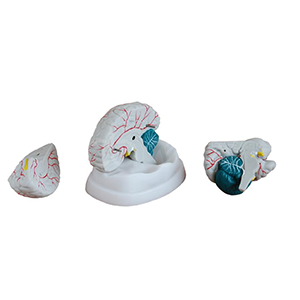
Short answer: BIX-A1050 is a life-size brain model divided into three pieces and mounted on a plastic seat. Its stated teaching purpose is the overall concept of the brain and the interrelationships between the brain, cerebellum and brainstem. It is the entry-level configuration in its series: fewer parts, one clear message, published size 18.5 × 14 × 13.5 cm, reference unit price $25.04.
Key takeaways
| Published feature | Teaching point |
|---|---|
| Demonstrates the overall concept of the brain | Establishes the whole before the parts — the correct order for a first lesson. |
| Shows the interrelationships between brain, cerebellum and brainstem | This is the specific lesson: three divisions, one another's positions. |
| Natural size (life-size) | Keeps the student's spatial judgment anchored to real proportions. |
| Divided into 3 pieces | Each division can be lifted and examined separately, then replaced. |
| Placed on a plastic seat | Stable for display and demonstration without a stand accessory. |
| Item | Published value |
|---|---|
| Product model | BIX-A1050 |
| Category | Anatomical Series → Brain Models |
| Parts | 3 |
| Size | 18.5 × 14 × 13.5 cm |
| Mounting | Plastic seat |
| Reference unit price | $25.04 (subject to order quantity) |
| Certification | ISO & CE certified per the page |
The argument for giving a beginner a physical object rather than a screen is well supported. A study comparing a physical model against three-dimensional computer models and textbooks for learning imaging anatomy found the physical model carried the advantage [1], and a meta-analysis of comparative studies concluded that physical models are effective in anatomy teaching [2]. Neither finding depends on the model being elaborate — the effect comes from the object being real and holdable.
There is a second, more practical argument for three parts. Handling time is a real cost in a lab session. A model that comes apart in three pieces can be dismantled and rebuilt by every student in the room in the time a nine-part model takes to lay out. For an introductory session, that is the difference between every student handling it and only the front row seeing it.
| Stage | Suitable configuration | Objective |
|---|---|---|
| First exposure | BIX-A1050 (3 parts) | Orientation: cerebrum, cerebellum, brainstem and their relationships. |
| Intermediate | ADA-304A (3 parts, new style) | Same relationship lesson with alternate modelling. |
| Advanced | ADA-304B (9 parts) | Internal structures and their correlation. |
| Skull and brain combined | ADA-135E (skull with 8-part brain) | Intracranial relationships. |
| Not stated on the page | Why you need it |
|---|---|
| Material | Affects weight, cleaning and handling durability. |
| Whether structures are painted or labelled | Determines whether the model carries its own naming cues. |
| Packaging dimensions and units per carton | Needed to price a class set. |
| Price at your order quantity and lead time | Reference price is explicitly subject to order quantity. |
Send these questions to ada-manikin@adaanatomy.com with the model number BIX-A1050 and your quantity, and we will answer each line and attach the current supply data.
Q1. What is BIX-A1050?
A new brain anatomical model at natural (life) size, divided into three pieces and mounted on a plastic seat, showing the overall concept of the brain and the relationships between the brain, cerebellum and brainstem.
Q2. How many parts does it have?
Three, as published on the product page.
Q3. What size is it?
18.5 × 14 × 13.5 cm.
Q4. Is it suitable for beginners?
Yes. Three parts is the simplest configuration in the series and is intended for orientation-level teaching.
Q5. How much does it cost?
The published reference unit price is $25.04, subject to order quantity.
Q6. How do I request a quotation for a class set?
Email ada-manikin@adaanatomy.com with the model (BIX-A1050) and the number of units; ask for carton data as well if the order is large.
Write to ada-manikin@adaanatomy.com for the BIX-A1050 specification sheet and a quotation. If your programme spans more than one level, ask for the 3-part and 9-part models in the same enquiry so the two tiers can be compared on real prices at your volume.






Leave a comment: