
Welcome to visit ADA MED SUPPLY LIMITED
Phone:+86 13383897707
Email:ada-manikin@adaanatomy.com
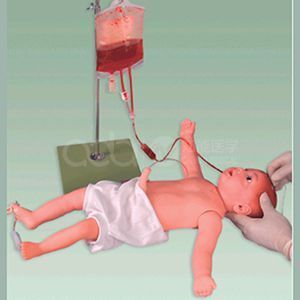
Model | BIX-FS9 — Advanced Infant Full-body General Venipuncture Manikin |
Summary | Advanced infant venipuncture manikin — scalp, hand, foot, neck sites with realistic skin for cannulation practice. For pediatric and NICU nursing programs. (149 chars) |
Training Sites | Scalp, hand, foot, neck (full-body coverage) |
Training Scope | IV cannulation, infusion, securement, pediatric technique |
Applications | Pediatric nursing, NICU orientation, med-surg programs |
Price | On request |
Configuration note: confirm the exact vein-site set, skin-puncture durability rating, and included infusion accessories with your supplier — ada-manikin@adaanatomy.com..
Pediatric IV access is not adult venipuncture on a smaller scale — it is a distinct procedural challenge with different sites, angles, and failure modes:
Small, shallow, mobile veins.
1. Infant veins are fine, superficial, and roll easily under the skin, making first-attempt cannulation hard even for experienced adult-care nurses (Kuensting et al., 2009).
Different sites.
2. The scalp vein, external jugular, foot, and ankle are routine infant access points that adult practice never touches.
No cooperation and real distress.
3. Infants cannot hold still or report sensation; restraint, positioning, and distraction are part of the procedure itself.
The consequence of untrained access attempts is predictable: repeated sticks, missed doses, delayed treatment, and distressed families. Simulation with deliberate practice is the evidence-based remedy — technology-enhanced simulation produces large effects on skills and behaviors (effect sizes 1.09–1.20 across skill domains; Cook et al., 2011), and deliberate practice on realistic task trainers reliably outperforms traditional clinical exposure (McGaghie et al., 2011). The AHA education guidelines likewise emphasize substantial hands-on practice to mastery with feedback for psychomotor skills (Bhanji et al., 2015).
Site | Typical Use | FS9 Training Value |
Scalp vein | Common in infants; visible, accessible | Site-specific cannulation + securement |
Hand / wrist veins | Routine peripheral access | Shallow-angle technique (10–15°) |
Foot / ankle veins | Alternative peripheral access | Vein stabilization without tourniquet over-tightening |
Neck (external jugular) | Emergency/alternative access | Positioning and angle control |
Full-body realism | Whole-manikin handling | Restraint, positioning, infusion management |
1. Identify all access sites on the infant manikin.
2. Practice positioning and gentle restraint for each site (supine for scalp, frog-leg for foot, etc.).
3. Palpate and visualize vein paths before any needle contact.
Step | Key Points |
1 | Site selection & hair-line orientation |
2 | Vein stabilization (traction proximal to insertion) |
3 | Shallow-angle insertion (10–15°), flashback check |
4 | Advance catheter, confirm patency |
5 | Securement: tape bridge technique, no circumferential wrap |
Rotate through sites with the same checklist, emphasizing site-specific angle and securement differences. Track first-attempt success per site.
Simulate a full task: prepare infusion set → cannulate → connect → regulate drip rate → secure → document. Run as a timed, observed scenario with structured debrief (gather-analyze-summarize).
Criterion | Standard |
Site selection | Correct for scenario |
First-attempt success | ≥ 3 of 5 attempts across sites |
Insertion angle | Correct per site (shallow for hand/foot) |
Flashback recognition | Verbalized immediately |
Securement | Tape bridge, no circumferential wrap |
Infusion management | Rate correct, no leakage |
Patient handling | Restraint safe and gentle |
Progression rule: trainees must pass Station A–B before supervised practice on live patients; NICU orientation programs typically require the full checklist (adapted to institutional policy).
Item | Frequency | Notes |
Vein-site skin | After heavy use | Replace worn segments to keep realism |
Cleaning | After each class | Mild soap and damp cloth; no solvents |
Infusion lines | Per program schedule | Use training-grade sets |
Puncture durability | Confirm rating | Ask supplier for cycles rating at ada-manikin@adaanatomy.com. |
Q1: What is the difference between BIX-FS9 and adult venipuncture arms like HS3? A: HS3 is an adult arm trainer for standard IV access. FS9 is an infant full-body manikin with infant-specific sites (scalp, foot, neck) and pediatric technique — a separate skill set for pediatric and NICU nurses.
Q2: Why is scalp vein training important? A: The scalp vein is a routine infant access site that adult practice never encounters. Site-specific training prevents first-day failures in pediatric wards and reduces repeated sticks, which distress infants and families (Kuensting et al., 2009).
Q3: Can the manikin support infusion practice, not just cannulation? A: Yes — the integrated infusion scenario (Station D) covers connection, drip-rate regulation, and securement. Confirm the included infusion accessories with your supplier.
Q4: Is simulation training proven to improve real venipuncture skills? A: Yes. Technology-enhanced simulation shows large effects on skills and behaviors (ES 1.09–1.20; Cook et al., 2011), and deliberate practice with feedback outperforms traditional exposure (McGaghie et al., 2011).
Q5: How durable is the skin at puncture sites? A: Training skins are replaceable. Request the cycles rating and replacement-skin price list from your supplier.
Q6: What is the MOQ and delivery time? A: MOQ is 1 unit. Air freight: 7–10 business days; sea freight for larger orders: 30–45 days. Email ada-manikin@adaanatomy.com. for a quote.
Difficult Venous Access in Children: Taking Control — Kuensting et al. (2009), J Emerg Nurs 35(5):419–424
Technology-Enhanced Simulation for Health Professions Education: A Systematic Review and Meta-analysis — Cook et al. (2011), JAMA 306(9):978–988
Does Simulation-Based Medical Education with Deliberate Practice Yield Better Results than Traditional Clinical Education? A Meta-Analytic Comparative Review of the Evidence — McGaghie et al. (2011), Acad Med 86(6):706–711
2015 AHA Guidelines Update for CPR and Emergency Cardiovascular Care — Education — Bhanji et al. (2015), Circulation 132(18 Suppl 2):S561–S573
"Let's Get Physical": Advantages of a Physical Model over 3D Computer Models and Textbooks in Learning Imaging Anatomy — Preece et al. (2013), Anat Sci Educ 6(4):216–224






Leave a comment: