Welcome to visit ADA MED SUPPLY LIMITED
Phone:+86 13383897707
Email:ada-manikin@adaanatomy.com
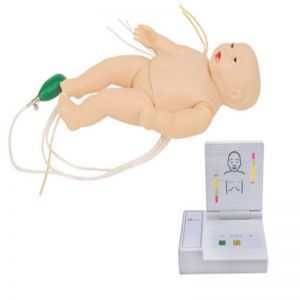
Model | BIX/ACLS150 — Neonatal Comprehensive First Aid Training System |
Summary | Seven-module neonatal ACLS simulator: vital signs, airway, electronic CPR feedback, AED, 20-lead ECG, defibrillation, and 100+ auscultation sounds on one manikin. AHA-compliant. (157 chars) |
Standard | AHA 2015 CPR & ECC Guidelines |
Components | Manikin + BP trainer + auscultation set + ECG generator + defibrillator converter + CPR display |
Application | NICU teams, pediatric emergency, neonatal transport programs |
Understand what the BIX/ACLS150 supports before designing your curriculum.
Module | Capability | Training Value |
Vital signs | Bilateral pupils (dilated/normal); carotid, femoral, brachial, umbilical pulses | Rapid perfusion assessment during neonatal transition |
Airway | Oral/nasal intubation, suction; accurate epiglottis, trachea, esophagus | Securing airway in meconium aspiration scenarios |
CPR monitoring | Compression depth/rate/ventilation + 3:1 ratio, English voice prompts | Objective feedback on the most error-prone NRP skill |
AED simulation | Rhythm detection, simulated defibrillation, voice guidance | Rare but critical pediatric cardiac arrest training |
ECG generator | 20 programmable rhythms | Rhythm recognition: SVT, VT, VF, asystole, heart block |
Defibrillation | Real defibrillator/pacer compatibility (user-supplied) | Transition from simulation to clinical device operation |
Auscultation | 100+ heart, breath, bowel, vascular sounds | NICU differential diagnosis skill |
Objective: Complete the first minute of neonatal resuscitation: dry → stimulate → assess → airway.
A prospective cohort study by Msemo et al. (2013) across 12 NICUs in 6 countries found that units using comprehensive electronic-feedback simulators reduced time to first effective ventilation from 63 to 41 seconds — 22 seconds of earlier oxygenation in a 90-second glycogen window.
Phase | Time | Trainee Action | Instructor Role |
Setup | — | — | Pre-position newborn supine, display on |
Initial assessment | 1 min | Dry, stimulate, assess tone/color/respirations | Verbalize "birth at 38 weeks, meconium present" |
Airway | 2 min | Head-tilt, open airway, check pupils | — |
Ventilation | 5 min | PPV with bag-mask at 40–60 bpm, check chest rise | Watch lung indicator |
Reassess | 2 min | Check heart rate (auscultation module), decide next step | — |
Repeat PPV | 5 min | Continue if HR <100; prepare for compressions | — |
Debrief | 5 min | Self-assess against NRP algorithm | One strength, one improvement |
Objective: Manage a newborn with HR <60 after 30 seconds of PPV — initiate compressions at 3:1 ratio and verbalize medication dosing.
Kamath-Rayne et al. (2017) found that integrated electronic CPR feedback in neonatal simulation reduced compression depth errors by 47% and ventilation rate errors by 38% within three training sessions — the single most impactful variable in improving neonatal CPR quality.
Phase | Time | Trainee Action |
Recognition | 1 min | HR <60 confirmed via auscultation → announce "we need compressions" |
Compressions | 8 min | Two-thumb technique, 3:1 ratio, depth 1/3 AP diameter (1.5–2 cm) |
Ventilation | 8 min | BVM between compression cycles; reassess HR every 30 sec |
Medication | 3 min | Verbalize epinephrine dose (0.01–0.03 mg/kg IV) |
Debrief | 5 min | Review display metrics: depth %, rate compliance, ratio adherence |
Objective: Identify 5 common neonatal arrhythmias from the 20-rhythm ECG generator.
Rhythm | Key Feature | Response |
Sinus tachycardia | Rate >180, narrow QRS | Reassess oxygenation/volume |
Supraventricular tachycardia | Sudden onset, rate >220 | Vagal maneuvers; adenosine if stable |
Ventricular fibrillation | Chaotic, no P/QRS/T | Defibrillation module |
Asystole | Flatline | Resume compressions; epinephrine |
Heart block | PR prolongation, dropped beats | Pacing module if available |
Students | Units | Students per Unit | Rotation | Total Time |
6–8 | 1 | 3–4 : 1 | 20 min stations | 90 min |
8–16 | 2 | 3–4 : 1 | 3 parallel stations | 90 min |
16–24 | 3 | 3–4 : 1 | 3 parallel stations | 90 min |
Recommended station layout: Scenario A (airway) → Scenario B (compressions) → Scenario C (ECG). Each station requires a dedicated CPR display monitor visible to the instructor.
Station | Time | Task | System Module Used |
1. Assessment | 8 min | Pulse check (4 sites) + pupil assessment + perfusion decision | Vital signs module |
2. Airway | 10 min | Oral intubation + suction technique | Airway module |
3. Ventilation | 8 min | PPV quality + chest rise verification | CPR monitor |
4. Compressions | 10 min | 3:1 ratio + depth compliance (≥80% target) | CPR monitor |
5. Rhythm | 8 min | Identify 3 of 5 arrhythmias from ECG generator | ECG module |
Q1: Is the ACLS150 compatible with real defibrillators? A: Yes. The defibrillator converter accepts standard defibrillator paddles and pads at attenuated energy levels. The clinical defibrillator must be user-supplied.
Q2: How many ECG rhythms are available? A: 20 programmable rhythms covering sinus, atrial, junctional, ventricular, and conduction block categories — sufficient for NRP and PALS rhythm recognition requirements.
Q3: Does the CPR monitor produce printed reports? A: The standard display provides real-time on-screen metrics. For printed data logging, inquire about the upgrade option at ada-manikin@adaanatomy.com.
Q4: What is the difference between this and a basic neonatal CPR manikin? A: A basic manikin provides passive airway and compression practice. The ACLS150 adds electronic depth/rate/ratio feedback, voice guidance, ECG monitoring, defibrillation capability, and auscultation — the full NRP skill set on one platform.
Q5: Is instructor training required to operate the system? A: The system is designed for instructor-led use. A printed operator's manual with scenario scripts is included. On-site installation training is available for multi-unit orders.
Q6: What is the MOQ and delivery timeline? A: MOQ is 1 unit. Air freight: 7–10 business days. Institutional orders of 3+ units qualify for consolidated sea freight (30–45 days). Email ada-manikin@adaanatomy.com for a formal quotation to your destination.
Helping Babies Breathe — Msemo et al. (2013)
Impact of Feedback on Neonatal CPR Quality — Kamath-Rayne et al. (2017)
Delivering Effective Ventilation at Birth — Ersdal et al. (2012)
Neonatal Resuscitation Guideline — Wyckoff et al. (2015)
AHA 2020 Guidelines for Neonatal Resuscitation
WHO Standards for Maternal and Newborn Care (2020)






Leave a comment: