
Welcome to visit ADA MED SUPPLY LIMITED
Phone:+86 13383897707
Email:ada-manikin@adaanatomy.com
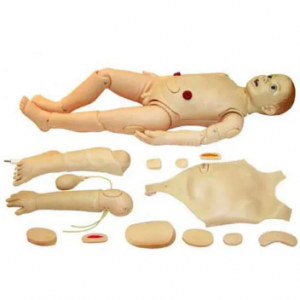
The BIX-FT333 is a three-year-old child care simulator built for paediatric nursing practice. The product page lists twelve core capabilities plus three optional modules, and a reference price of US $589.20 before freight. It is a task-and-scenario manikin, not a full-body child simulator: there is no walking, no speaking and no spontaneous deterioration.
Quick answer. The FT333 is worth buying when a programme needs one body that covers paediatric airway, vascular access, feeding, elimination and hygiene at a realistic three-year-old size. It is the wrong purchase if the curriculum depends on auscultation, defibrillation or ECG monitoring — those are options, and they change the price.
| Skill group | What the learner can do | Assessment value |
|---|---|---|
| Eye assessment | Compare normal and dilated pupils side by side | Neurological observation practice |
| Hygiene care | Bathing, dressing, hair combing, eye and ear cleaning | Routine child care routine |
| Airway | Oral intubation, sputum suction, oxygen therapy | Anatomically modelled mouth to trachea |
| Feeding | Oral and nasal feeding, gastric lavage | Tube placement and checking |
| Vascular access | Arm venipuncture, injection, transfusion with flashback | Palpable pop and blood return |
| Intramuscular injection | Bilateral deltoid, vastus lateralis and gluteal sites | Site selection on a child |
| Elimination | Enema, rectal suppository, urinary catheterisation | Paediatric catheter sizing |
| Holistic care | Sponge bath, clothing change, cold and heat therapy | Sequence and dignity |
| Joint movement | Limbs bend, rotate and lift for bathing and bandaging | Positioning technique |
| Ostomy care | Ileum, colon and bladder fistula care | Stoma appliance routine |
| Marrow puncture | Tibial site with surface landmarks and simulated marrow flow | Paediatric-specific access site |
| Point-of-care testing | Finger blood collection, TB test | Capillary sampling technique |
The three optional modules are auscultation (heart, breath and bowel sounds), defibrillation and pacing with real devices, and ECG monitoring with a supplied monitor.
Paediatric nursing errors cluster around scale. A catheter that is correct for an adult is wrong for a three-year-old; a tibial marrow needle that is correct for a neonate is wrong here. A simulator sized as a three-year-old forces the learner to choose equipment by body size rather than by habit, which is the decision that transfers to the ward.
The published evidence on manikin fidelity is mixed but consistent on one point: fidelity helps most when the task requires anatomical discrimination, and helps least when the task is a checklist [1]. The FT333 sits on the favourable side of that line, because its value is in the airway, the tibial site and the IM sites rather than in the scenario drama. Paediatric simulation studies also report that structured practice with a physical manikin improves procedural confidence compared with video-only preparation [2].
| Field | Value on the product page |
|---|---|
| Model | BIX-FT333 multifunctional three-year-old child care simulator |
| Category | Paediatrics and gynaecology models |
| Age representation | Three-year-old child |
| Core skills | Twelve, from eye assessment to tibial marrow puncture |
| Optional modules | Auscultation; defibrillation and pacing; ECG monitoring |
| Vascular access | Arm venipuncture with pop and blood return |
| Reference price | US $589.20 before freight |
| Certification | ISO 9001, ISO 14001, ISO 45001 |
Q1. Is the FT333 a high-fidelity simulator? It is a task trainer with scenario capability. There is no automatic deterioration, no crying and no speaking; the instructor drives the scenario.
Q2. Are heart and breath sounds included? No. Auscultation is listed as an optional function. Confirm the option price before comparing quotations.
Q3. Can it be used for defibrillation practice? Only with the optional defibrillation and pacing module, which is designed to work with real devices from different manufacturers.
Q4. What age does it represent? A three-year-old child. It is not suitable for neonatal or infant sizing exercises.
Q5. Which access sites are available? Arm venipuncture and injection, bilateral deltoid, vastus lateralis and gluteal intramuscular sites, finger blood collection, and tibial bone marrow puncture.
Q6. What is the price and what is excluded? US $589.20 is the reference price for the base unit before freight. Optional modules, replacement skins and consumables are additional; request an itemised quotation.
Contact. For an itemised quotation including the optional modules, or the consumable price list, email ada-manikin@adaanatomy.com. Product page: https://www.ada-manikin.com/pediatric-gynecological/three-year-old-child-care-simulator-FT333 · Paediatric and gynaecology models: https://www.ada-manikin.com/pediatric-gynecological-models · All articles: https://www.ada-manikin.com/neslist.html






Leave a comment: