Welcome to visit ADA MED SUPPLY LIMITED
Phone:+86 13383897707
Email:ada-manikin@adaanatomy.com
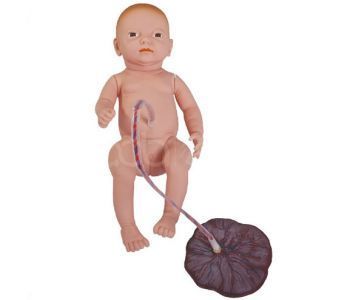
The F132 is a female newborn nursing model built around one procedure that decides a lot of outcomes: umbilical cord care. It carries a realistic cord with an umbilical vein and an artery, the head and limbs move, and the cord is long enough to be ligated and cleaned repeatedly, with spare cords supplied. The product page does not publish a price.
Quick answer. Buy the F132 if your learners must clamp, clean and inspect a cord on a body that also accepts basic newborn care — feeding, sponge washing, dressing and nappy changes. Do not buy it if you need a resuscitation manikin or an intravenous access trainer; the F132 has no airway for intubation and no vessel for cannulation.
| Item | Detail on the product page | Teaching consequence |
|---|---|---|
| Model | F132 neonatal umbilical cord nursing model | One body, cord-focused |
| Body | Female newborn, movable head and limbs | Positioning and handling can be practised |
| Cord | Umbilical vein and artery moulded in | Two-vessel anatomy is visible, not implied |
| Reuse | Cord long enough for continued use, spare cords supplied | A cohort can practise without one learner per cord |
| Basic care | Lactation, sponge washing, dressing, nappy change | The cord is taught inside a care sequence |
| Price | Not published | Quotation required |
Cord care fails in small ways: a clamp left too close to the skin, a stump that stays wet under a nappy, a cleaning motion that pulls instead of lifting. None of these are visible on a doll without a cord, and none of them are safe to rehearse for the first time on a newborn.
The F132 makes the stump the centre of the exercise. Because the cord carries a moulded vein and artery, a tutor can also explain why a single artery or a two-vessel cord is abnormal, and why that finding triggers a renal ultrasound in practice. That is a knowledge point most dolls cannot support, because they have a cord-shaped stub with nothing inside it.
The parent-instruction step is the one most courses skip and the one that changes behaviour at home.
Email ada-manikin@adaanatomy.com with the number of learners and the cord-care protocol you teach, and ask for the spare-cord pack price at the same time, because cords are the part that wears first.
Delayed clamping is now the default in term infants who do not need resuscitation, and the third-stage guidance links clamping timing to newborn outcomes. A model cannot teach timing, but it can anchor the conversation: learners who have handled a cord understand what "leave it intact for a minute" actually means for the person holding the baby.
Cord hygiene advice also differs by setting. Dry care is the norm in high-income settings, while chlorhexidine is used where neonatal mortality from omphalitis is high. The F132 is neutral on this: it lets a tutor demonstrate either method without implying one is universal.
| Field | Value |
|---|---|
| Product number | F132 |
| Category | Nursing skill models, pediatrics and gynaecology |
| Body | Female newborn, movable head and limbs |
| Cord | Umbilical vein and artery, reusable length, spare cords |
| Procedures | Cord ligation and nursing, lactation, sponge washing, dressing, nappy change |
| Reference price | Not published; quotation required |
| Certification | ISO 9001, ISO 14001, ISO 45001 and CE |
Q1. Does the F132 include spare cords? Yes. The page states multiple standby umbilical cord models are supplied, and that the cord length allows continued use.
Q2. Can learners practise umbilical catheterisation? No. The cord is a nursing model, not a cannulable vessel.
Q3. Is the baby full-term size? The page describes a female newborn systemic model without a centimetre dimension. Ask for length and weight if your course uses them.
Q4. What does it cost? No price is published. Request a quotation with the spare-cord pack included.
Q5. Can it be used for bathing practice? Yes. Sponge washing and dressing are listed among the procedures, so the body is sealed for wet use.
Q6. Can the head and limbs be positioned? Yes. The head and limbs are movable, which supports handling and positioning practice.
Contact. For a quotation with spare cords, or the body dimensions, email ada-manikin@adaanatomy.com. Product page: https://www.ada-manikin.com/nursing-model/neonatal-umbilical-cord-nursing-model-F132 · Nursing skill models: https://www.ada-manikin.com/nursing-skill-models · All articles: https://www.ada-manikin.com/neslist.html






Leave a comment: